Silver Bahama Pintail
| |
|
![]() |
Scientific Name: Anas bahamensis fonna alba |
| Geographical Range: Widely distributed. Caribbean West Indies and coastal regions of northern South America, including the Galapagos. It is occasionally seen in the southern United States. | |
| Habitat: Freshwater or brackish ponds, lagoons,
and lakes. |
|
| Conservation Status: Not threatened. | |
| Diet in the Wild: Seeds, snails, insects, roots and tubers. | |
| Location in the Zoo: Water Fowl Exhibit |
|
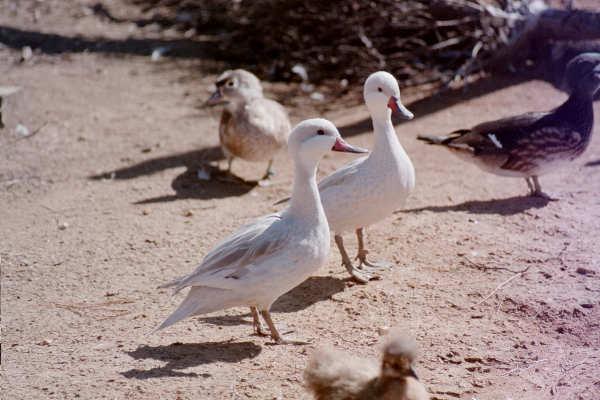
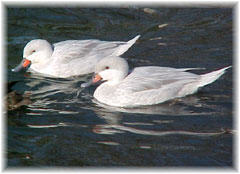
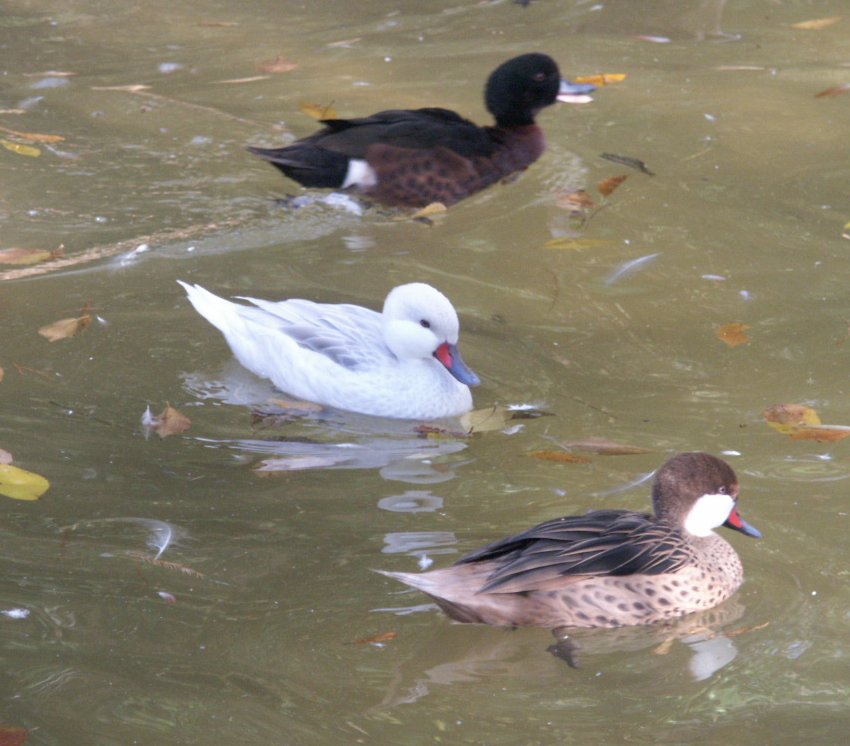
| Physical Description: Size: 38-48 cm. Weight: 503-524 grams. Head and neck medium brown with white cheeks. Bill blue gray with red side patch. Body pale brown with darker spots. Wing primaries darker brown with pale fringes. Feet and legs are gray. Females are smaller than males with slightly duller
feather and bill color. Both have a full white body with patches of gray spots
along with burnt orange webbed feet. That weighs from 1 to 2 lbs.
The female is the biggest weighing up to 2 lbs. |
Social Organization: Social groups
are pairs or small groups. Mainly male and female couples stay together
watching over their ducklings. For approximately four months,
the duckling will stay with their original group. New groups are
usually formed by the male. These ducks do almost everything as
a couple or as a group. Their bonding is unlimited in the wild
since they need each other to survive. |
|
Special Adaptations: Pintails are dabbling ducks. The "dabbling" refers to their feeding behavior rather than a swimming style. Their feet are located more toward the center of the body rather than toward the rear, as in diving ducks. Dabbling ducks collect food at the water's surface, although occasionally they can go end-up to retrieve something from the bottom. Their long necks allow them to go deeper in water than other ducks. Feeding also occurs on land which the ducks have to search around for insects and seed usual in coastal areas. The food is gathered by groups or individuals while the nest is being built. |
![]() |
| Reproductive Behavior: Reproductive season is generally through the months of July - November depending on their region of migration. Males can breed all year long between groups, where as, the female breeds once a year. Nests are constructed by the females only or with groups. A nest is constructed on the ground in thick vegetation. After 5-12 buff colored eggs are laid, they are incubated by the female for about 25 days. Once hatched the females and sometimes the males will attend to their parental guidance of the young ducklings. Ducklings are small at hatching, but they they are
ready to fly in 6 weeks. Sexual maturity is reached at the end
of their first year; however they may not breed until their second year.
Adults can live for 10-15 years. |
The Animal at the Zoo: These duck share a man made of pond with othe
ducks and ducklings. Feeding is done with a special diet of fish
and seed. |
| Page Author: Sources and Links: |
|